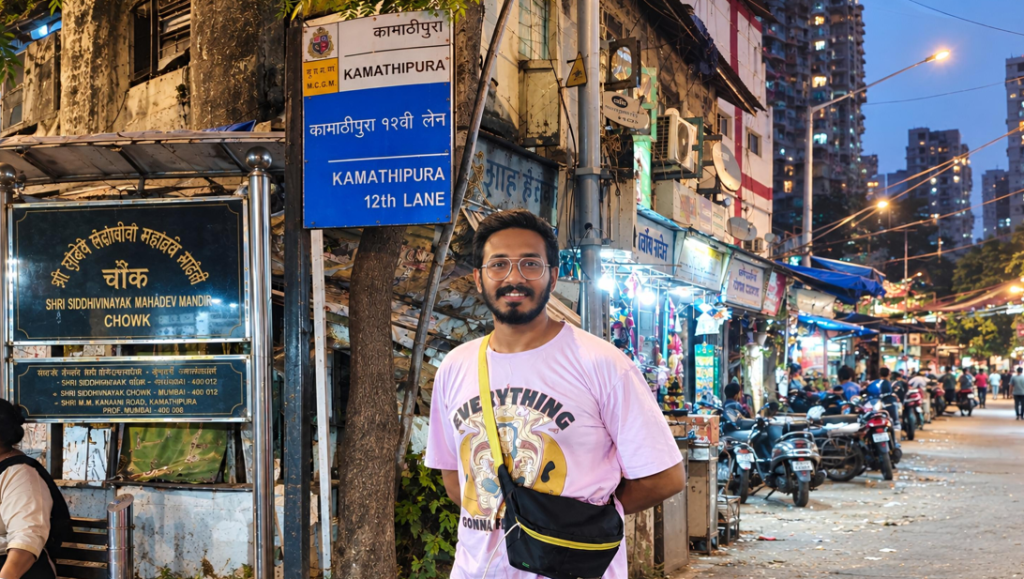
Kamathipura at a Crossroads: Dhaval Pitale Documents a Neighbourhood Facing Extinction
India is one of the most diverse countries in the world, home to countless religions, languages, cultures and communities. But when we look closely at our cities, we often find smaller neighbourhoods where these identities have lived together for generations.
One such neighbourhood exists in the heart of Mumbai — Kamathipura.
Once associated with the Kamathis who settled in the area, Kamathipura changed dramatically over the years and eventually became widely known as one of Mumbai’s oldest red-light districts. But the area has always been more than the identity attached to it.
It has been home to families, workers, migrants, traders, sex workers, transgender people and generations of residents who have built their lives within its narrow lanes.
Today, Kamathipura is once again standing at a turning point.
With redevelopment gradually changing the physical landscape of the neighbourhood, an important question remains: what happens to the people, memories and history connected to a place when the place itself begins to disappear?
Filmmaker Dhaval Pitale is attempting to document this transition through an independent documentary on Kamathipura — its past, its present and the uncertain future that lies ahead.
The documentary explores the complicated history of the area while looking at the influence of colonialism, capitalism, migration and urban redevelopment. It also raises difficult questions around trafficking, violence, crime and sex work, while trying to understand how these realities have changed over generations.
Rather than looking at Kamathipura only through the familiar image of a red-light district, the film focuses on the people who have lived there and the social world that has developed around them.
It also looks at the changing nature of sex work itself.
As Kamathipura changes, sex work has not necessarily disappeared. Instead, it has increasingly moved beyond the traditional boundaries of the neighbourhood, taking different forms across Mumbai and its surrounding regions.
This raises another question at the centre of the documentary: if the buildings disappear, does the stigma disappear too?
Dhaval is also closely associated with the Aadhishakti Sarvajanik Ganeshotsav Va Navratraotsav Mitra Mandal, a local mandal based in Kamathipura.
The festival brings together residents from different communities, including sex workers and transgender people, who participate alongside other local families and members of the neighbourhood.
For Dhaval, this is an important part of Kamathipura’s identity that rarely finds space in mainstream narratives about the area.
Behind the stories of crime, sex work and stigma is another Kamathipura — one built around community, faith, celebration, coexistence and everyday life.
The documentary attempts to capture both these realities without romanticising the neighbourhood or reducing it to its darker history.
One of the central concerns of the film is what will remain once redevelopment is complete.
Will the name Kamathipura continue to carry the same stigma?
Will the identity of the neighbourhood change completely?
Will the younger generation know what once existed there?
And perhaps most importantly, who will remember the lives and stories that never became part of official history?
Dhaval hopes the documentary can preserve some of those memories before they disappear.
The idea is not simply to make a film about a red-light district, but to create a visual record of a neighbourhood undergoing one of the biggest transformations in its history.
The documentary could eventually serve as a reference for future generations, researchers, sociologists and historians trying to understand Kamathipura beyond the way it has traditionally been portrayed.
Dhaval is also the founder of Aadhya Films, where he works with Associate Director Priyanshi Rathor on different film and creative projects.
For this documentary, the team is also experimenting with emerging AI tools and visual technology.
Artificial intelligence will be used selectively to help recreate certain historical periods and environments that can no longer be filmed today. Combined with research, archival material and real accounts, these visual reconstructions will attempt to give audiences a sense of how Kamathipura may have looked and lived during different periods of its history.
But at its heart, the film remains about people.
About what happens when development reaches a neighbourhood with a complicated past.
About whether removing old buildings can really remove the stigma attached to the people who once lived inside them.
And about whether redevelopment can create a new future without completely erasing what came before.
The documentary ultimately leaves audiences with one deliberate question:
What if Kamathipura’s story had gone differently?
What if, instead of simply disappearing under redevelopment, the neighbourhood had been given a new way of living while still preserving its communities, stories and history?
For Dhaval Pitale, this question is not about holding on to the past for the sake of nostalgia.
It is about asking what Mumbai loses when its neighbourhoods change beyond recognition — and what parts of their history may still be worth saving.
https://www.instagram.com/aadhya.films?stkn=a3pncHVyeTRidXJ5
Ganadhisha Mumbaicha : https://www.instagram.com/ganadhishamumbaicha?stkn=dGg5cm00MTg1ZnYw