Built to Grow: App Dev Company on Designing Mobile Apps That Scale With a Business
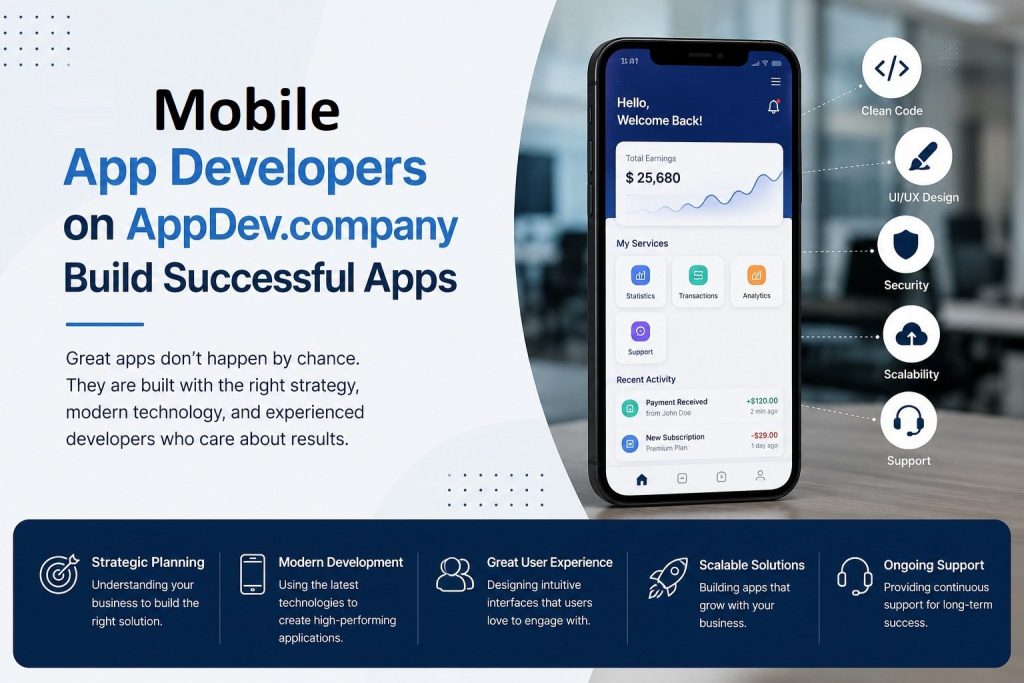
Many mobile apps are built for the business a company is today, not the business it hopes to become — a gap that often forces a costly rebuild once growth actually arrives. App Dev Company, working with its associated mobile app developers, positions scalable architecture as a core design consideration rather than a concern to address only once growth pressure becomes unavoidable.
According to the company, its approach involves designing applications capable of supporting increasing traffic, larger databases, and new functionality without requiring the entire application to be rebuilt from scratch as a business expands. This forward-looking approach to architecture requires anticipating growth scenarios during initial development, a planning step that adds some upfront complexity but can avoid considerably more expensive rework once an application needs to handle meaningfully higher load than it was originally built for.
Why Scalability Problems Surface at the Worst Possible Time
Applications that weren’t designed with scalability in mind tend to reveal that limitation precisely when a business can least afford disruption: during a period of rapid growth, increased marketing spend, or a viral moment driving unexpected traffic, when application slowdowns or failures directly undermine the business momentum the growth itself represents. Professional mobile app developers generally treat this timing risk as a core argument for investing in scalable architecture early, even when a business’s current traffic doesn’t yet require it.
What Scalable Architecture Actually Involves
Scalability isn’t a single feature but a set of architectural decisions — how a database is structured, how backend services are organized, how the application handles concurrent users — that collectively determine how gracefully an application handles increased load over time. An App Dev Company that builds with future expansion in mind, rather than solely addressing an application’s current requirements, generally aims to avoid the scenario where a business’s own commercial success becomes the trigger for a technical crisis.
FAQ
Why would a small business need scalable architecture from the start?
Growth can happen faster than anticipated, and applications not designed to scale often require costly rebuilding precisely when a business is trying to capitalize on new demand rather than manage a technical crisis.
Does building for scale increase initial development costs?
Generally yes, to some degree, though the added upfront cost is typically smaller than the cost of a full application rebuild triggered by unanticipated growth later.
How do developers decide how much scalability to build in from day one?
This generally depends on a business’s growth projections and risk tolerance, balancing near-term development cost against the potential cost of future rework if growth exceeds initial expectations.
For businesses planning a new application, discussing growth scenarios directly with a development partner during the planning phase — rather than assuming scalability can be addressed later without cost — remains a reasonable way to avoid the more expensive rebuild path down the line.
Cloud infrastructure has made certain aspects of scalability considerably easier to manage than in earlier eras of software development, since cloud providers now offer tools that can automatically adjust server capacity in response to changing traffic, reducing some of the manual infrastructure planning that scaling once required. That said, infrastructure scaling alone doesn’t solve every scalability challenge, since database design and application architecture decisions still meaningfully affect how well an application performs as usage grows, regardless of how elastic the underlying cloud infrastructure is.
Visit- https://appdev.company/